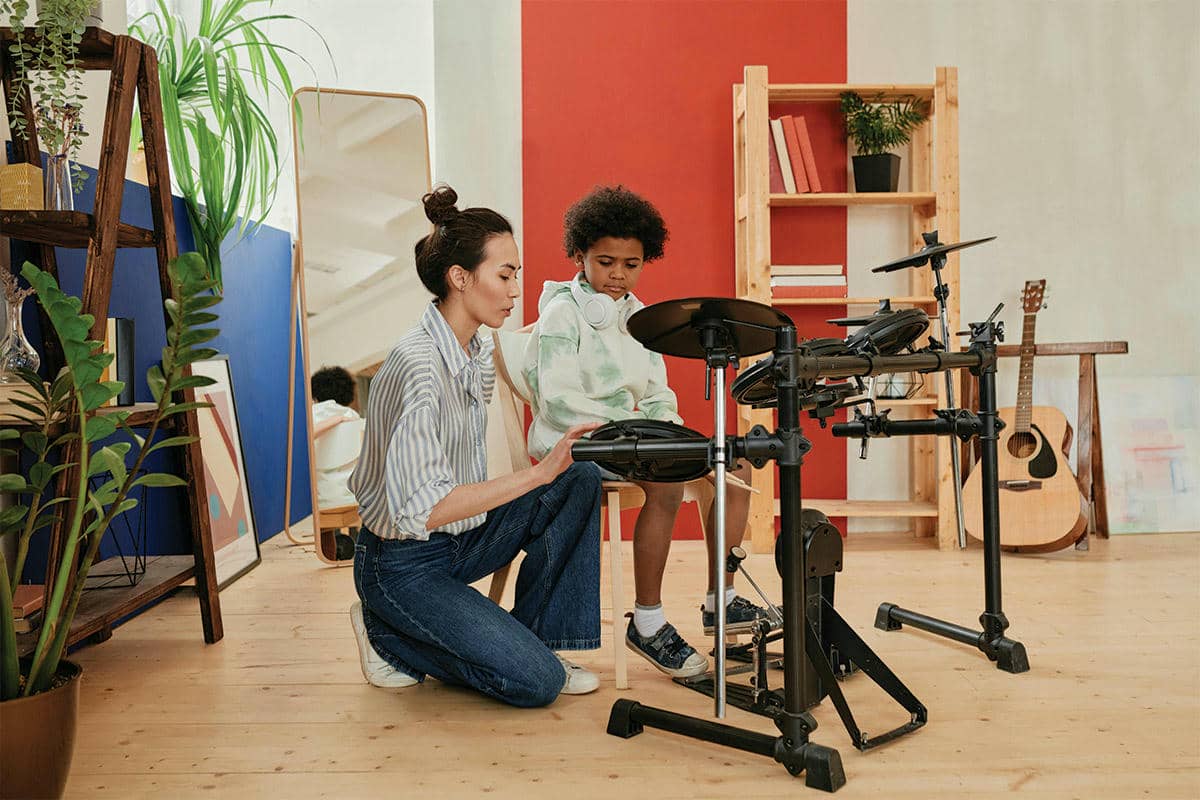
What are Drums vs. Electronic Drums?
While both instruments allow you to play rhythm and percussion, they produce sound in fundamentally different ways.
Acoustic Drums
These are the traditional drums you see in rock bands and orchestras.
How they work: They have a physical shell (usually wood) and a “head” (plastic skin) stretched over the top. When you hit the head, the air inside vibrates to create sound.
Key Features:
Feel: They offer natural “rebound” (how the stick bounces back) and dynamic control (ghost notes, rim shots).
Volume: They are naturally very loud and require no power source.
Maintenance: Heads need to be replaced and tuned regularly.
Electronic Drums (E-Drums)
These are digital instruments designed to mimic the layout of an acoustic kit.
How they work: You hit rubber or mesh pads that have sensors (triggers) inside. These sensors send a signal to a digital “brain” (module) which plays a pre-recorded sound sample through headphones or an amplifier.
Key Features:
Volume Control: You can play silently with headphones, making them ideal for home practice or apartments.
Versatility: You can change the sound of the entire kit instantly (e.g., from a rock kit to a techno kit).
Size: They typically take up less space and are easier to fold up or move.
Why Are Drum Lessons Good & What Is the Process?
Drum lessons provide structure that prevents bad habits (which can lead to injury or limited speed) and accelerates learning.
The Benefits
Full-Body Coordination: Drumming requires “limb independence”—using your four limbs to do different things simultaneously. This engages the entire brain and improves motor skills.
Stress Relief: The physical act of drumming is a high-energy outlet for stress and anxiety.
Academic Improvement: Studies show that rhythm training helps with pattern recognition, which correlates with improved math and language skills.
Confidence: mastering a difficult groove and keeping time for a band builds significant self-assurance.
The Learning Process
A typical drum curriculum follows a progression like this:
Grip & Posture: Learning how to hold the sticks (matched grip vs. traditional grip) to maximize speed and minimize wrist strain.
Rudiments: Practicing fundamental stick patterns (like the Single Stroke Roll, Double Stroke Roll, and Paradiddle) on a practice pad.
Reading Rhythm: Learning to read drum notation (quarter notes, eighth notes, rests).
The “Money Beat”: Learning the basic rock groove (kick on 1 & 3, snare on 2 & 4).
Limb Independence: Exercises to separate the hands from the feet.
Song Application: Playing along to real music to understand timing and “feel.”
Why is CIMA (Central Illinois Music Academy) Best for Drum Lessons?
CIMA, or “Central Illinois Music Academy” can help with your Drum Lessons. We can provide and help with:
Customized Curriculum: Unlike generic online tutorials, a local academy like CIMA can tailor the lesson plan to the student’s specific goals (e.g., “I want to play in the school jazz band” vs. “I want to play rock music”).
Qualified Instructors: The best academies employ instructors who are active performers. They don’t just teach theory; they teach “gigging” skills—how to set up gear, how to tune drums, and how to play with other musicians.
Performance Opportunities: Top-tier academies often organize recitals or student bands. Drumming is a social instrument, and getting students out of the practice room and onto a stage is crucial for growth.
Community Connection: Being local to the Central Illinois/Peoria area means the academy understands the local music programs (school bands, contests) and can prepare students specifically for those auditions.