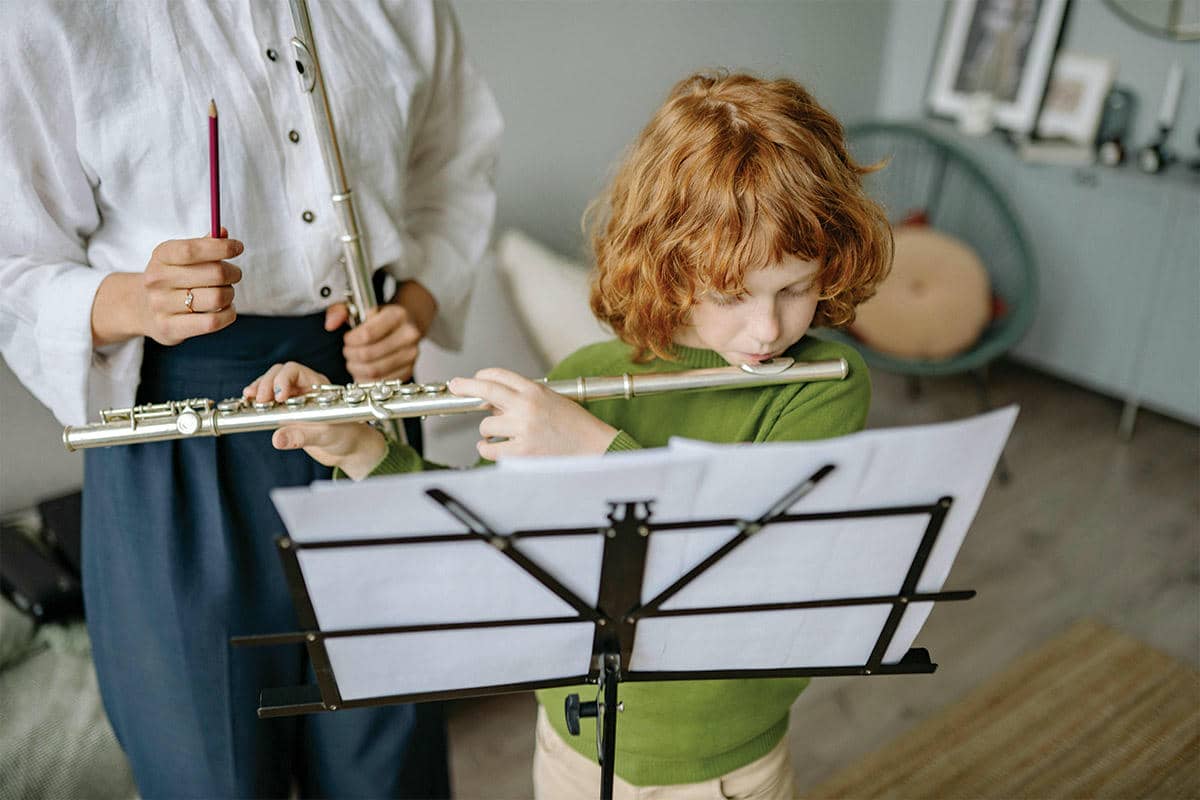
What is a Flute?
The flute is a member of the woodwind family, though modern flutes are typically made of metal (silver, nickel, or gold).
How it works: Unlike clarinets or saxophones, the flute is reedless. You produce sound by blowing a focused stream of air across an opening (the embouchure hole) in the head joint. This splits the air stream, causing the air inside the tube to vibrate.
Role in Music: It is the soprano (highest pitched) voice of the woodwind family. It is known for playing the melody in orchestras and bands and is famous for its bright, clear, and bird-like tone.
Why Are Flute Lessons Good & What Is the Process?
Because the flute relies entirely on your air stream and mouth shape (embouchure) to create sound, “self-teaching” often leads to dizziness and poor tone. Lessons provide the necessary technique to play effortlessly.
The Benefits
“The Breather’s Workout”: Playing flute requires more controlled air volume than almost any other instrument (even the tuba!). It significantly strengthens your lungs, diaphragm, and core muscles.
Posture & Poise: Holding a flute requires a specific asymmetrical posture. Lessons teach you to hold it without tension, improving your overall body awareness and alignment.
Cognitive Sharpness: Coordinating your fingers (fine motor skills), reading music, and controlling your breath simultaneously is a massive workout for the brain, improving focus and memory.
School Band Success: For students in Central Illinois, the flute is a competitive section. Private lessons are the “secret weapon” for passing auditions and getting better chair placements in school bands.
The Learning Process
A professional curriculum typically follows these steps:
The Head Joint: Beginners often start by playing only the head joint (the top piece) to master the “embouchure” (mouth shape) without worrying about fingers.
Breathing Technique: Learning to breathe “from the stomach” (diaphragmatic breathing) rather than the chest to prevent dizziness.
First Notes (B, A, G): Adding the body of the flute and learning the left-hand notes first.
Tonguing: Learning to use the tongue to start and stop notes cleanly (articulation).
Reading Music: connecting the notes on the page (treble clef) to the fingerings.
Why is CIMA (Central Illinois Music Academy) Best for Flute Lessons?
Choosing a dedicated academy like CIMA over a generic music store or online video offers distinct advantages for a student in the Peoria/Central Illinois area:
Specialized Woodwind Instructors: CIMA prioritizes instructors who are specialists. You aren’t learning from a generalist; you are learning from a flutist who understands the specific nuances of embouchure and breath control.
ILMEA & Contest Prep: Being a local academy, CIMA instructors are likely familiar with the Illinois Music Education Association (ILMEA) audition requirements. They can specifically coach students on the scales and etudes needed to make District and State bands.
Performance Application: Flute is a melodic instrument meant to be heard. CIMA typically provides performance opportunities (recitals) that build confidence and help students overcome stage fright.
A “Music First” Environment: Unlike a retail store where lessons are a side business to sell gear, an academy’s primary product is education. The focus is entirely on the student’s growth, not on selling a new instrument upgrade.